Sydney Property Outlook 2027: Why Investors Are Retreating — and When Buyers Should Prepare
Business Growth HQ | 23 November 2026
Sydney property prices are falling, investors are retreating, and five interest rate increases in 2026 have changed the economics of buying property.
But is Sydney property becoming cheaper — or simply becoming less attractive as an investment?
At Business Growth HQ, we believe the answer lies in understanding several forces working together: government taxation changes, rental yields, financing costs, borrowing capacity and a weakening employment market.
Our current view is that March to September 2027 could present a window worth watching for property buyers. However, we believe the market still faces significant challenges before a sustainable recovery can begin.
1. Sydney property prices have fallen significantly
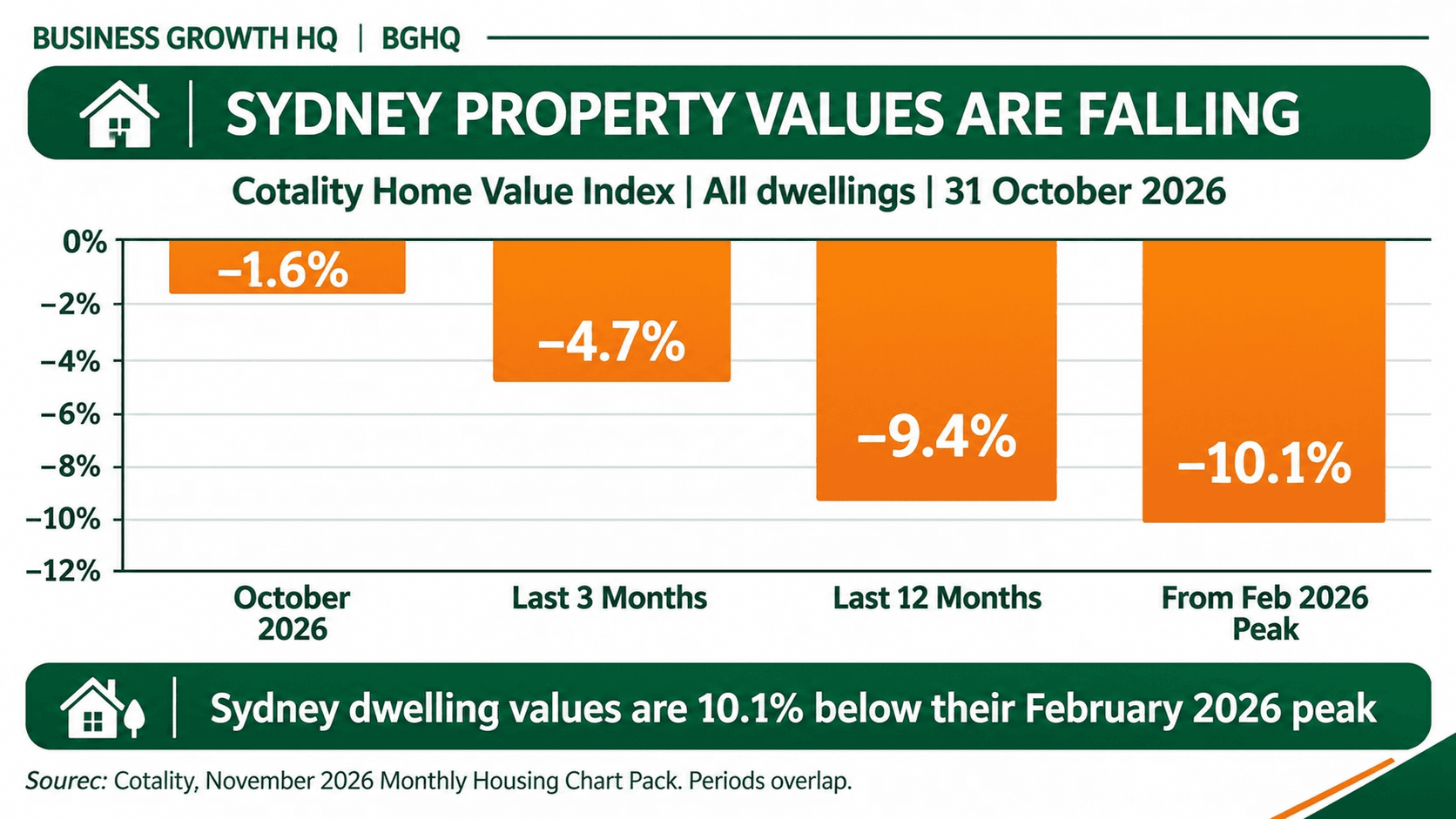
According to Cotality's October 2026 housing data, Sydney dwelling values have fallen 10.1% from their February 2026 peak.
The market recorded a 1.6% decline in October alone, a 4.7% decline over the preceding three months and a 9.4% decline over the year.
These figures suggest the market correction is well underway.
However, lower prices do not necessarily mean better investment opportunities.
For investors, the important question is whether the expected rental income, financing costs and long-term capital growth justify the purchase price.
And increasingly, the numbers are proving difficult to reconcile.
2. Where Have All the Property Investors Gone?
The latest Australian Bureau of Statistics (ABS) lending figures reveal a striking change in Australia's property market.
Investors are withdrawing from the market at a much faster rate than owner-occupiers.
Who is taking out new housing loans?
During the September 2026 quarter, there were:
76,578 owner-occupier loans — 68.4% of new lending commitments
35,301 investor loans — 31.6% of new lending commitments

Source: ABS Lending Indicators, September quarter 2026. National new housing loan commitments by number, excluding refinancing.
But the proportion of loans tells only part of the story.
Investor lending has fallen off a cliff
The quarterly changes are considerably more revealing.
OWNER-OCCUPIER LENDING
Down 5.3% by number and 5.3% by value.
INVESTOR LENDING
Down 30.6% by number and 32.3% by value.
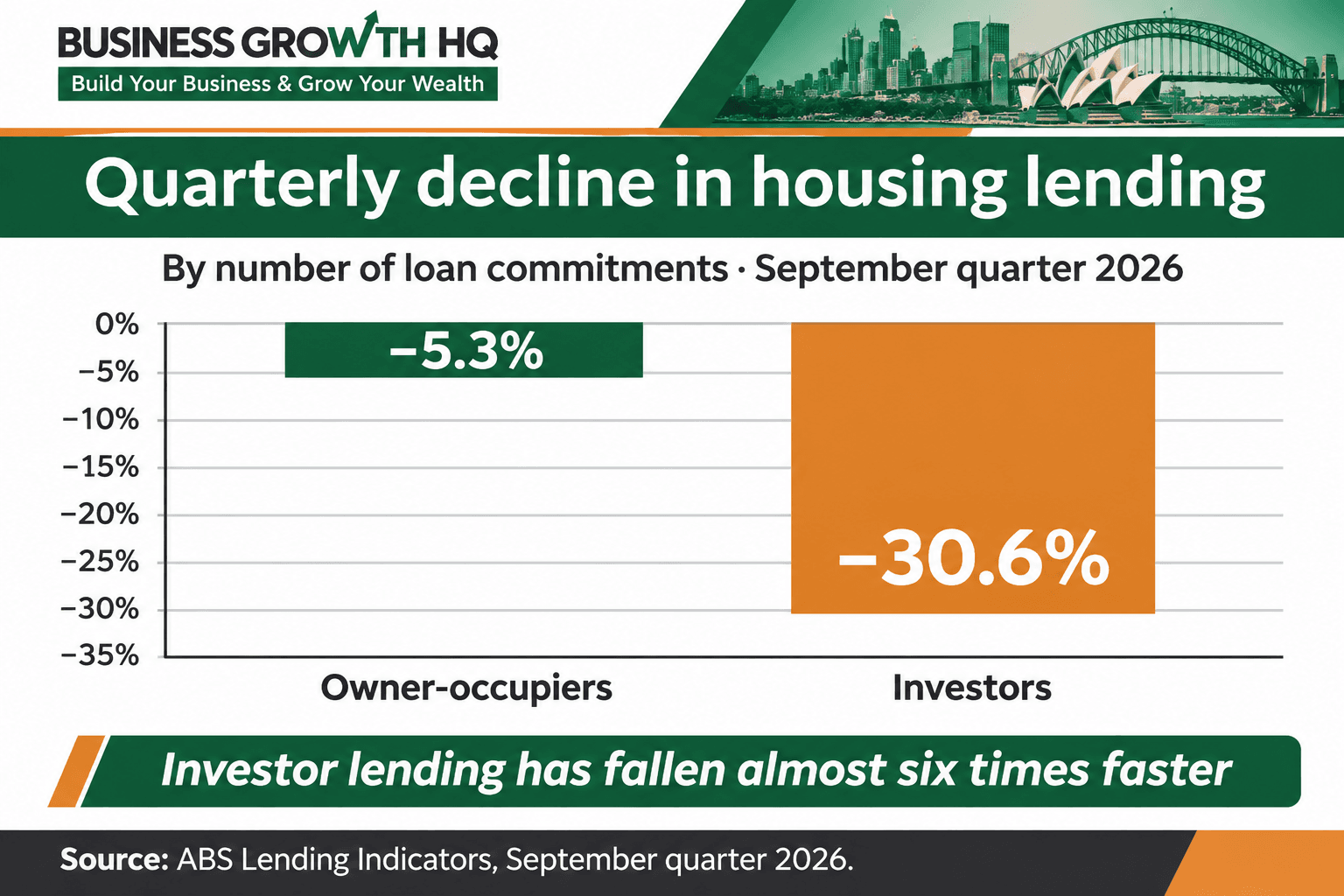
Investor lending has contracted approximately six times faster than owner-occupier lending.
That is a substantial difference.
The ABS reported that the quarterly declines in investor lending were the largest on record for those series.
Why does this matter for Sydney property prices?
Owner-occupiers generally purchase property because they need somewhere to live.
Investors approach the decision differently.
They consider rental income, borrowing costs, tax benefits, capital growth and the risks of holding the investment.
When the numbers no longer make financial sense, investors can simply choose not to buy.
At Business Growth HQ, we believe the changes to negative gearing are a major contributor to this dramatic slowdown, particularly when combined with higher interest rates and weak rental yields.
The national ABS lending figures do not establish the precise impact of each factor or directly measure Sydney property transactions.
However, they highlight a significant change in investor borrowing behaviour.
And when a major group of potential buyers withdraws from the market, that can place further downward pressure on property prices.
This brings us to what we believe is one of the most important factors behind the investor retreat: the government's changes to negative gearing.
3. Negative gearing: The government's changes are reshaping investor demand
At Business Growth HQ, we believe the negative gearing reforms are a leading explanation for the dramatic reduction in investor activity, particularly in established residential property.
Under the Federal Government's May 2026 Budget reforms, negative gearing of residential investment property will generally be restricted to eligible new builds from 1 July 2027.
Properties held before the Budget announcement are grandfathered.
For affected established residential properties acquired after Budget night, investors will no longer be able to offset rental losses against unrelated income such as wages. Instead, the new rules allow losses to be applied against qualifying residential property income, with excess losses carried forward.
Why is this important?
Consider an investor who incurs an annual rental loss of $40,000.
Under the existing rules, an eligible investor paying a marginal tax rate of 47%, including Medicare levy, could potentially obtain an immediate tax benefit of $18,800 from offsetting that loss against other assessable income.
Under the new rules, an affected investor may lose access to that immediate deduction against salary income.
That changes the household cash-flow equation considerably.
For years, investors have accepted negative cash flow because they anticipated future capital growth and benefited from tax deductions along the way.
When the immediate tax benefit is restricted, the investor must fund more of the holding cost from their own income.
We believe this is particularly significant when rental yields are already low and mortgage rates are high.
The ABS figures demonstrate the scale of the investor lending slowdown. They do not, however, prove that tax reform alone caused it. Higher interest rates, weaker price expectations and other market conditions are also contributing factors.
4. Rental yields: Before the Budget versus October 2026
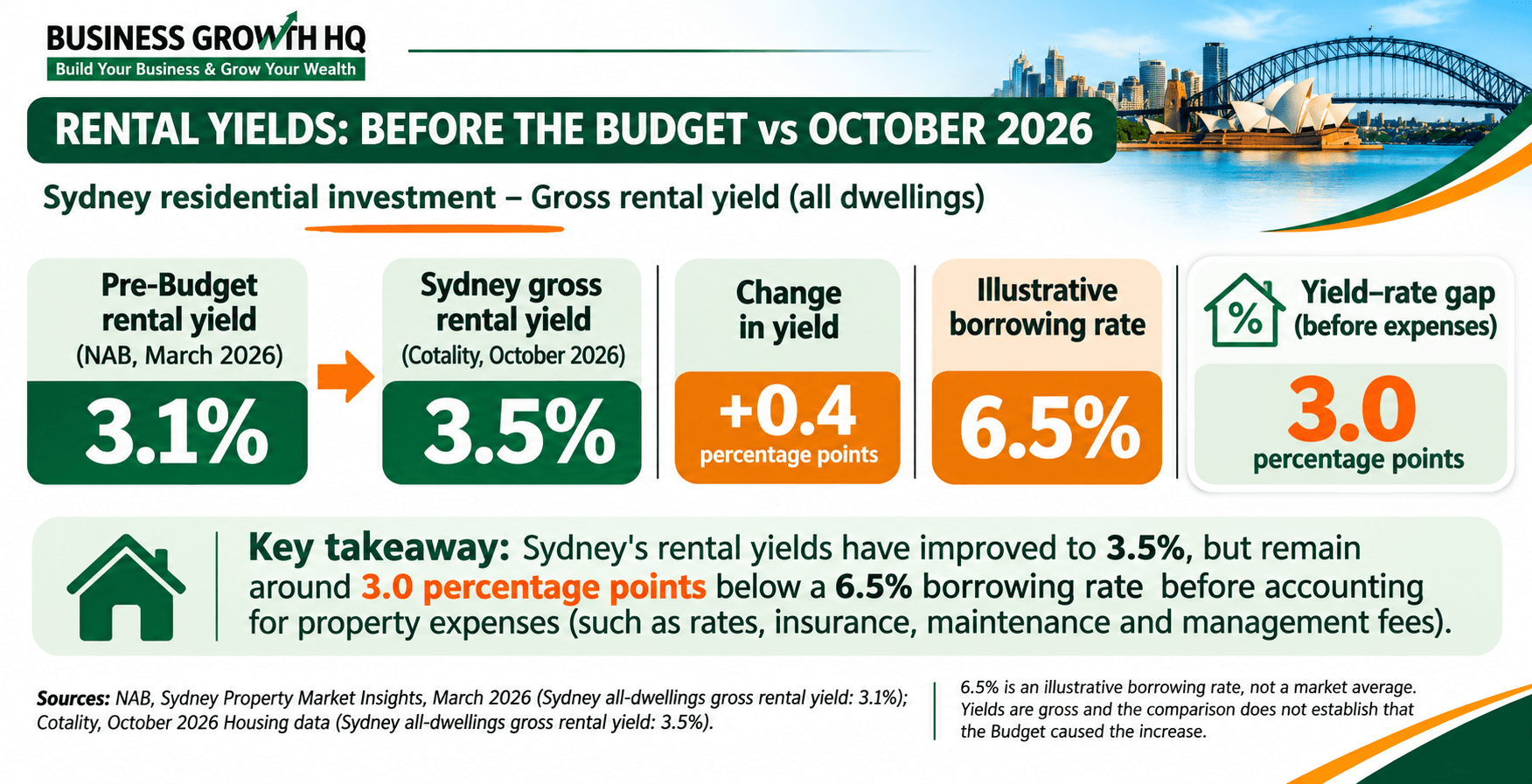
Cotality's October 2026 data shows Sydney's gross residential rental yield at approximately 3.5%.
This represents an improvement from the lower yields prevailing before the May Budget, as falling property prices and rental movements have changed the relationship between rents and property values.
However, the important issue is whether the improvement is sufficient.
Assume an investor can borrow at an interest rate of 6.5%.
That leaves a three-percentage-point gap between Sydney's gross rental yield and the borrowing rate, before accounting for property expenses.
Consider the following example.
A $1.5 million Sydney investment property
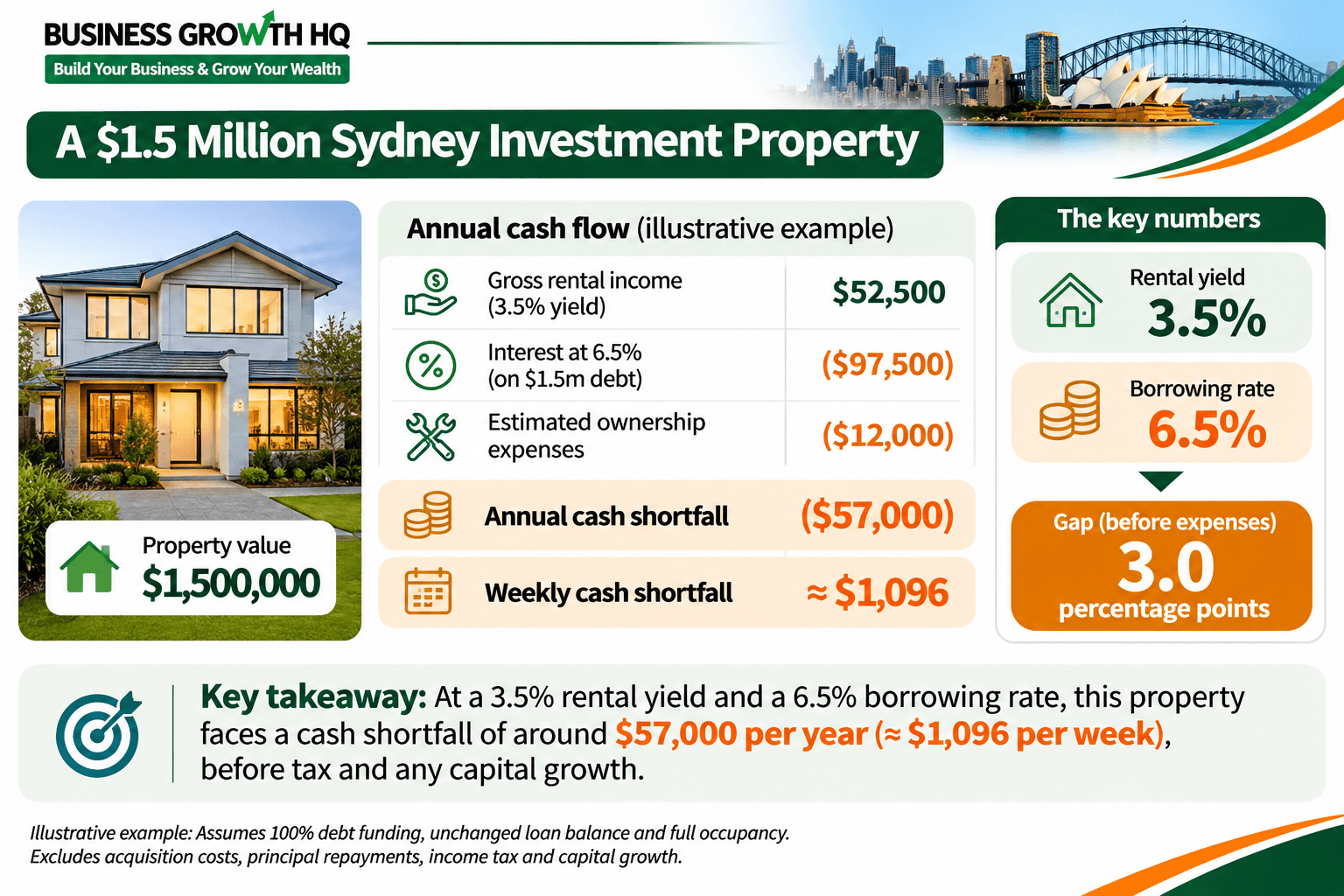
| Gross rental income at 3.5% | $52,500 |
| Interest at 6.5% on $1.5m debt | ($97,500) |
| Estimated ownership expenses | ($12,000) |
| Annual cash shortfall | ($57,000) |
| Weekly cash shortfall | Approximately $1,096 |
Illustrative example assuming 100% debt funding, unchanged loan balance and full occupancy. Excludes acquisition costs, principal repayments, income tax and capital growth.
Even at a lower loan-to-value ratio, investors may still face negative cash flow.
The fundamental question is whether the expected capital growth is sufficient to compensate for the ongoing holding costs and investment risks.
Our view is that a falling purchase price is not, by itself, a compelling reason to invest.
Rental yields need to be assessed against financing costs, ownership expenses and realistic expectations of future capital growth.
5. Five interest rate rises: The double impact on borrowers
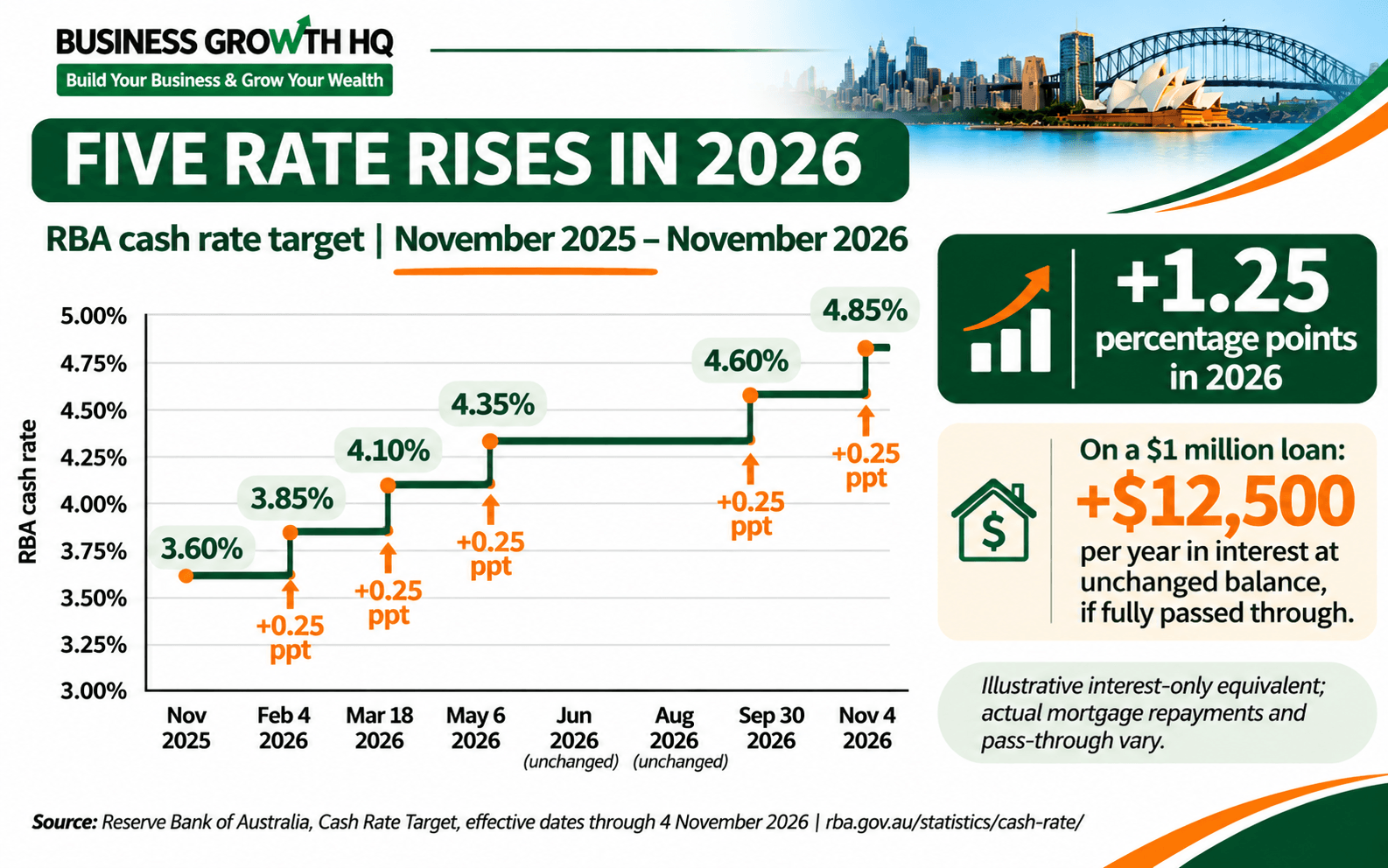
The Reserve Bank increased the official cash rate five times during 2026, taking it from 3.60% to 4.85% by November.
That is a cumulative increase of 1.25 percentage points.
The effect on mortgage holders is substantial.
What does every 0.25% increase cost?
| $500,000 | $1,250 | $104 |
| $750,000 | $1,875 | $156 |
| $1,000,000 | $2,500 | $208 |
| $1,500,000 | $3,750 | $313 |
Assumes the full 0.25-percentage-point increase is passed on. These are interest-cost equivalents, not calculated principal-and-interest repayment changes.
For a $1 million mortgage, the cumulative 1.25-percentage-point increase represents approximately $12,500 in additional annual interest, assuming the loan balance remains unchanged.
But higher interest rates create a second problem: reduced borrowing capacity.
Banks generally assess borrowers using an interest rate above the actual mortgage rate, commonly incorporating a three-percentage-point serviceability buffer.
As mortgage rates rise, the assessment rate rises too.
Consequently, existing borrowers have less disposable income, while prospective buyers may qualify for smaller loans.
This creates downward pressure on purchasing power.
6. Capital gains tax changes: Important, but not the end of the investment case
The government's capital gains tax reforms will also affect property investors.
From 1 July 2027, the general 50% CGT discount will be replaced by arrangements involving inflation-based cost-base adjustments and a minimum 30% tax on relevant real gains.
Transitional arrangements and exceptions apply, including different choices for eligible new builds.
These changes may reduce after-tax capital gains for some investors.
However, we do not believe the CGT reforms necessarily destroy the long-term investment case for residential property.
A few percentage points of additional effective tax may be manageable if an investment delivers strong capital growth, appropriate rental returns and acceptable risk.
The impact depends on the investor's circumstances, ownership structure, inflation, holding period and actual gain.
In our view, the more immediate concern for highly leveraged investors is the ongoing annual cash-flow shortfall.
An investor may accept a somewhat lower after-tax gain in ten years.
They may be far less willing to fund substantial annual losses today, particularly where negative gearing benefits have been restricted.
7. Falling property values are reducing available equity
Many investors use equity in an existing property to fund their next acquisition.
Consider a homeowner with a property worth $1.5 million and an outstanding mortgage of $900,000.
At an assumed maximum loan-to-value ratio of 80%, their potentially accessible equity is $300,000.
If the property value falls by 10%, that figure reduces to $180,000.
A 10% fall in property value has reduced potentially usable equity by 40%.
This does not mean the homeowner has lost 40% of their total wealth.
It means their capacity to release additional equity has fallen significantly.
We believe this can further restrict investment activity because some investors who would otherwise be willing to purchase may no longer have sufficient accessible equity to fund their next deposit.
However, it is not necessarily the end of their investment strategy.
Borrowers with substantial equity, stable earnings and adequate liquidity may still be well positioned to act when suitable opportunities arise.
8. Rising unemployment: The risk that could become more serious
One of the most important indicators we are now monitoring is employment.
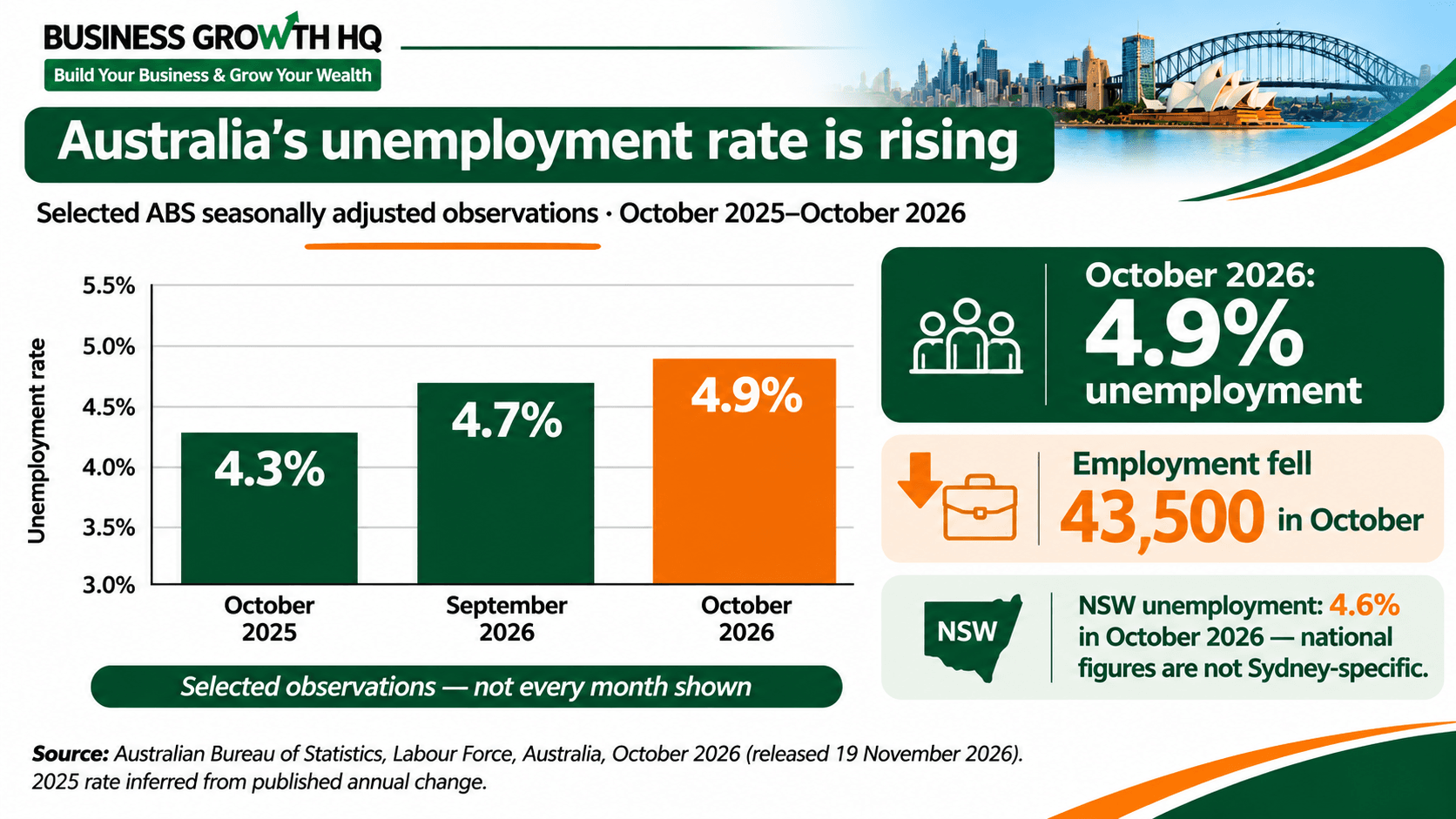
The ABS reported that Australia's seasonally adjusted unemployment rate increased to 4.9% in October 2026, the highest level since October 2021.
Employment fell by approximately 43,500 people during the month.
Why does this matter for property?
A housing market can generally withstand price declines while borrowers remain employed and can service their mortgages.
The situation becomes more difficult when falling property values coincide with job losses.
A household that loses one income may struggle to meet mortgage repayments, particularly after successive interest rate increases.
If unemployment continues to rise, mortgage arrears and distressed selling could become increasingly important influences on the market.
We are not suggesting widespread mortgagee sales are inevitable.
However, we believe employment conditions could become one of the most significant risks to Sydney property prices during 2027.
9. When might Sydney present a buying opportunity?
At Business Growth HQ, our current view is that March to September 2027 could present a period worth watching for buying opportunities.
By then, the cumulative effects of interest rate increases may be more fully reflected in household budgets, borrowing capacity and property values.
Investors will also be approaching the commencement of the new taxation arrangements.
However, identifying the exact bottom of a property market is extremely difficult.
We will continue monitoring property price momentum, auction clearance rates, advertised stock, investor lending, unemployment, mortgage arrears and the direction of interest rates.
We also recognise that Sydney's long-term housing supply constraints have not disappeared.
A short-term property correction and a longer-term housing shortage can exist at the same time.
10. What should property owners and investors do now?
Before we go any further, this is by no means personal financial advice. Everyone's financial situation is unique. Here's our thought process.
Property ownership, borrowing capacity, income stability, tax circumstances and long-term objectives vary significantly from one person to another.
What may be appropriate for one homeowner or investor could be completely unsuitable for someone else.
However, based on the current property market conditions, here is our thought process at Business Growth HQ.
For owners who genuinely need to sell
Consider your options sooner rather than later. If selling is unavoidable, waiting for a market recovery may expose you to further price declines and additional holding costs.
For example, a further 3% to 5% decline on a $1.5 million property would represent approximately $45,000 to $75,000 in additional lost value.
This is an illustrative scenario, not a forecast or a recommendation that everyone should sell.
For owners who can comfortably hold
There may be no reason to panic.
Review your cash flow, mortgage structure, interest rates and financial reserves. If your repayments remain manageable and your circumstances are stable, holding through the property cycle may be a reasonable option.
For borrowers experiencing financial pressure
Act before your options become limited.
Consider reviewing your existing mortgage, refinancing opportunities, available cash reserves and potential hardship arrangements with your lender.
For first-home buyers
Start preparing rather than trying to predict the exact bottom.
Build your deposit, reduce unnecessary debt, understand your borrowing capacity and research the suburbs where you want to live.
A lower purchase price is only beneficial if the property remains affordable over the longer term.
For established investors with substantial equity and stable income
This may be a period to prepare for opportunities rather than rush into purchasing.
Review your existing portfolio, assess available equity and consider the relationship between rental yields, borrowing costs and future capital growth.
Commercial property may also warrant consideration for suitable investors, although vacancy, tenant concentration, financing and liquidity risks require careful assessment.
The BGHQ perspective
We believe the next stage of Sydney's property cycle will reward financially prepared buyers who understand both the opportunities and the risks.
The question is not simply whether property prices will fall another 5%.
It is whether an investment delivers acceptable returns, whether the borrowing is sustainable and whether the purchase fits the investor's longer-term financial position.
Don't rush. Don't overextend yourself. But be financially prepared.
At Business Growth HQ, we combine accounting, taxation, business advisory and mortgage broking experience to help clients evaluate property decisions.
Whether you are considering refinancing, purchasing an investment property, reviewing your existing portfolio or exploring commercial property, speak with our team before making your next move.
Business Growth HQ — Build Your Business & Grow Your Wealth
About this commentary
Business Growth HQ provides accounting, taxation and business advisory services, alongside an associated mortgage broking business.
This article represents our analysis of publicly available property, economic and lending information. It is general commentary only and does not constitute personal financial, investment, taxation or credit advice. Everyone's circumstances are different, and professional advice should be obtained before making financial decisions.
Our businesses may receive professional fees or mortgage broking remuneration where clients engage our services. Relevant conflicts of interest are disclosed and managed in accordance with applicable professional obligations.
Information current as at 23 November 2026. Financial examples are illustrative and based on stated assumptions.

Arrange Your FREE
No-Obligation Meeting
Either phone us on (02) 8824 7848 or complete the form below



Download now and get your
business off to a flying start!

With higher interest rates, low rental yields and rising unemployment, is Sydney approaching a buying opportunity?
Business Growth HQ examines the latest property market indicators, the risks facing investors and homeowners, and why 2027 could present opportunities for financially prepared buyers. More >